Showing posts with label student stories. Show all posts

Thursday, January 11, 2018

Alumni Hightlights: The Path of MD-PhD by Jared Smith, 2015

Jared Smith (class of 2015) is a UNP alumnus who is currently in an MD/PhD. He can be contacted at jarasmit@iupui.edu if you have any questions.

Why did you decide to major in neuroscience?


"I had an interest in history, chemistry, biology, philosophy and psychology when I entered college freshman year. Until school started, I had never heard of the neuroscience major but when I met a couple neuroscience majors within the first couple days of school I realized that this major involved all my interests. At this point I was interested in thinking, memory, and emotion—neuroscience as a major seemed the best way to learning more about all these interests. Additionally, my interest in neuroscience mainly stemmed from my interest in philosophy; however, as I matured I realized that neuroscience would be a better area to pursue than philosophy as neuroscience would provide a better, more tangible avenue to test, create, and evaluate philosophies."


Has being part of UAB’s UNP helped you so far in your medical and graduate careers?

"I honestly don’t know if I would have been interested in research as much, if at all, without the UNP. The requirement to work in a lab starting in freshman year exposed me to that environment, and without that requirement, I don’t know if I would have worked in a lab. Without working in a lab I would not have developed my research ideas/interests and would not be on the MD/PhD path that I am now on."

What was the process of applying to MD/PhD programs like? Was the MCAT as scary as people make it out to be?

"The process of applying MD/PhD starts in undergrad. Although I did not shadow at all in college, I sought out leadership and lab opportunities such as being an SI leader for General Chemistry. I started doing research with Dr. Rita Cowell in the spring of freshman year and stayed in that lab through graduation. I also participated in a summer pre-MD/PhD program at The Ohio State University between my junior and senior years. When I was applying I was worried about my lack of shadowing; however, from attending conferences and talking to people involved in MD/PhD admissions, shadowing is helpful but is not as emphasized as applying MD-only. On the other hand, research experience is a must. In summary, I would highly recommend simply doing a couple things you really enjoy doing rather than doing a lot of activities a little. This will show in interviews and on your applications when asked to explain more about what you may have done.

Applying to MD/PhD programs was a bit intimidating at first due to the high selectivity of the programs; however, after meeting other people interested in the dual degree in summer MD/PhD summer programs, on the interview trail, and in research labs, I realized that I felt like this path would suit me better than pursuing either the PhD or the MD alone. To apply MD/PhD one needs to have substantial/enough research experience and have interests in both degrees. The average MD/PhD program is ~7.5 years so those interested must make sure that this is truly a path that the person wants to pursue.
I think what’s most important when applying (besides the obvious decent grades and MCAT) is having a good personal statement and good letters of recommendation. Everyone applying to MSTP programs is also competing against people in the general MD-only applicant pool for spots in a medical school class, so it is important to illustrate in your personal statement what makes you unique whether that’s difficult times you’ve been through or circumstances that really shaped you. I did not write a personal statement that showed all that I had done; instead, I wrote a personal statement detailing obstacles I had overcome. I think writing a personal statement that is more personal sets it apart from the typical “I’ve always wanted to be a doctor” or “I like to help people” essays that are very common, although genuine, themes. The same goes for letters of recommendation. Having a good letter writer who genuinely knows your strengths and weaknesses, and wants to see the best for you will be very evident to admissions committees and give more weight than a weak letter of recommendation (which may actually hurt you in some cases). I spent the majority of my time on my personal statement, I asked my letter writers months in advance, and submitted my AMCAS in a one-week span after I completed the MCAT at the end of September (not recommended).
The application for MD/PhD requires a couple more AMCAS essays than applying MD-only. On the AMCAS not only is there a personal statement for medical school, but those applying to MD/PhD programs also must complete a maximum 3,000 character “Why do you want to do MD/PhD” essay along with a 10,000 max character Research Statement essay where you detail what research you’ve done, your role in the project, what the outcome of the research was, any conferences you may have attended to present the research, and what you learned from the project that helped you develop as a person (specifically one interested in MD/PhD). Also, after submitting your primary AMCAS application, which sends your application out to all the schools you want, schools will send you secondary applications. Secondaries essentially want to know why you are particularly interested in a certain school and why they should pick you. These are like the MD-only application except that for some schools, applying MD/PhD requires you to not only apply to their medical school but also their graduate school as well. Therefore, the secondary will be longer because you will have graduate school essays to answer as well. The secondaries can get a little pricey, so be sure to keep that in mind.
I personally ended up applying to 4 MD/PhD/MSTP programs and 1 MD-only program. I honestly forgot to turn in one of the MD/PhD secondaries; however, I received interview offers at the other 3 programs and from the MD-only program. Compared to MD-only interview, some of the MD/PhD interviews were 3 days long where the first was for travel and meeting everyone and the second and third days were for interviewing with both graduate and medical school interviewers. Travel, meals, and housing at these interviews, at least where I applied, were covered by the programs I was applying to. Biggest advice for interviews: know your stuff, relax, and be yourself. No one knows your life, your experiences, and what you’ve done better than yourself.

I think the MCAT is what you make it. If you know yourself and maximize learning in your own way, I think it goes well, if not, then it won’t. But it is important to stay confident and practice preparing for the MCAT by taking practice tests to build up your “test day” stamina."

You’re currently an MS2. What’s a typical day in your life like? Are you currently doing any research, or will that wait until after you’ve finishes your second year of medical school?
"Currently? Step One prep as I have to take the exam in March. Right now we have block classes where we have a new class that starts and finishes within 6 weeks with exams every 2 weeks concluding with a final NBME exam at the end of the 6th week. I actually enjoy the blocks because they’re not too bad once you get into your rhythm and know how you learn best. Currently I have class (sometime mandatory, sometimes not) every morning from 8-12 and have every afternoon off to study or do whatever else I want to do. I stay active in intramural sports with other medical professional students and we play various sports a couple times of week, weather permitting. I personally aim to take Friday and Saturday off from studying to relax and enjoy time with my friends. As for research...I am not doing research during my MS2 year. As part of MD/PhD we are required to do lab rotations summer before MS1 and summer between MS1 and MS2 so that when we finish our Step One exam, we have our lab picked out and can start on our project. I just recently picked the lab to complete my PhD."


What’s been the best part of medical school so far? Is there anything in particular that you’re looking forward to?
"Patient exposure has been the best part for me. I did not do any shadowing in college and so getting the chance to work in the clinic as a medical student has been an invaluable experience. All the information you learn through college and medical school (i.e glycolysis enzymes, etc.) you actually get to see the real-life effect that lacking an important molecule, protein, or receptor can actually substantially affect health. Seeing that everything you’ve learned is not just book knowledge but something you can meet in the flesh shows you that all the information is important and valuable. I’m really looking forward to working the wards in third year after grad school; however, I’m really looking forward to grad school as well. Bringing all the clinical information I’ve absorbed since start of MS1 into grad school could help have a different perspective when it comes to my thesis and grad school work. I’m curious to see how it all shakes out myself."

What advice would you give to current neuroscience undergraduate students interested in applying to MD/PhD (or other MD dual degree) programs?

"With anything but particularly with MD/PhD, you need to be sure of yourself and that you truly want to walk the path you think/believe you do. Most importantly, that it is yourself, not others, for wanting to walk that particular path. MD/PhD is a longer program averaging about 7-8 years per individual. A lot of life can happen in that time. As most programs are setup, you start off with a med school class then transition to graduate school while those med school friends will graduate and move onto residency while you may be struggling with an experiment in your 2-3rd year of grad school. Then as you finish grad school you may lose contact with those grad school friends as you transition back to 3rd year of medical school and they transition to post doc positions. Meanwhile you’re in a new medical school class with people who have been together for the last 2 years of medical school, not to mention you may be a couple years older than these peers. It is imperative to know where you stand and have a good group of people around you whether that is family, friends, or whatever you may find support in.
It is a long path, but I wholeheartedly believe it is worth it. The experience and perspective you obtain is invaluable. 1% of all MDs are MD/PhD—otherwise known as unicorns. Not only are you the expert in a medical field, but you’re also a qualified expert in a research field. The combined expertise may allow the individual with the MD/PhD to see things a bit differently as that individual may have additional experience that the MD-only or PhD-only individual may not have. You meet a lot of great people on the journey and get the best of both the clinical and research worlds. And although you may end up making less than someone who simply does MD-only and follows the exact same career path due to that person getting in the workforce earlier, it does make it a little easier (at least for me) to not have to worry about money, tuition, or loans during this time since MSTP/ dual MD/PhD programs give stipends and cover graduate and medical school tuition.
P.S- be sure to know the difference between MSTP programs and dual MD/PhD programs. Although a MSTP is a dual MD/PhD program, the converse of that statement is not necessarily true. The reason this is important is that MSTP programs are NIH-funded and therefore medical tuition is covered. At some non-MSTP, dual MD/PhD programs an individual may end up paying for their medical tuition; yet, their graduate school will be covered."


Written by Jasmine Cunningham

Monday, September 25, 2017

My Life in Norway: A Study Abroad Memoir by Remy Meir

In the spring of 2017 I decided to embark on a life-changing journey. I stuffed my
bags with winter clothes and jetted off to Oslo, Norway. I spent six months studying abroad at the University of Oslo and it was by far the most impactful experience of my college career. Not only was the country absolutely breathtaking, but also the people I met and the experiences we shared will not be easily forgotten. However, when I first arrived, I really had to work to adjust to Norwegian culture. They are a pretty reserved group of people. It took some time to break through the reserved shell that a lot of Norwegians have, but once you were in, you had a friend for life. The easiest way I found to make friends with locals was to get involved on campus and pick up hobbies that Norwegians love. There is a running joke that Norwegians are born with skis on their feet, however when I was there, I quickly learned this was not a joke. In order to blend in, I rented cross-country skis from my university and then spent most weekends and some days after class hitting the snow-covered hills behind my student village. I think that was one of my favorite parts of Norway, how perfectly intertwined the nature and cities were and how the people who lived there take full advantage of it.


Beyond my involvement in traditional Norwegian activities, I also got involved in a research lab on campus. Prior to leaving home, I reached out to a professor at the University of Oslo to ask if I could intern in her lab during my semester abroad. She was incredibly accommodating and welcomed me into her lab with open arms. I enjoyed working with her so much that I am trying to return to Norway to complete my research project. In order to do so I am applying for the Fulbright Scholarship. This scholarship would fully fund me to live in Norway for ten months in order to complete my research. If someone had asked me freshman year if I saw myself applying for Fulbright in the future I would have just laughed. However, now that I have built up so much support on my campus and had the experience of applying and winning Goldwater, I want to continue to push myself. I think that more students should try to apply for these awards because you never know how it will impact your life.


For me studying abroad was more than seeing the Northern Lights, learning to cross-country ski, or even working in a foreign research lab. It was about throwing myself into a new experience and figuring out how I could take advantage of all the opportunities at my fingertips. Completely submersing yourself in a different culture gives you a new perspective on the world and can help you see a clear path for your future. I can honestly say that all my friends that studied abroad would tell future students the same thing. We all came back with a new outlook on life that helped to shape the future we see ahead of us. If you are hesitant about studying abroad, throw that nervous energy away and head to the education abroad office. A student never comes back saying that they regret the time they lived in another country, students regret never taking that chance. Go out, learn something new, meet someone new, and take advantage of all life has to offer. 


Q&A:
1.    Describe your time at Norway and the enjoyable moments.
I studied abroad spring of 2017 at the University of Oslo in Norway. One of my favorite things about being in Europe was that I got to travel to Italy, Slovenia, Poland, Latvia, Lithuania, Sweden, and the Netherlands.  I also thoroughly enjoyed exploring Norway from the fjords to the Northern Lights; Norway had some of the most breathtaking nature I have ever experienced. I’m also a huge winter person so being able to cross-country ski almost every weekend was a ton of fun, and then as soon as it warmed up we traded in our skis for hiking boots.


     2. What were some of the shocks and challenges that you had to overcome?
One of the challenges I had to overcome was adapting to Norwegian culture. They are a pretty reserved group of people, so making friends was initially a challenge. However, once I started to get involved on campus and with different hobbies it was easy to create new friendships. I also developed a lot of close relationships with other international students helping me to gain a better perspective on the world as well as some of my closest friends. The only other thing that posed a real challenge was initially learning how to navigate public transportation. I have never lived in a city almost completely dependent on public transportation, so learning how to get around via bus and t-bane was a whole new world. However, once I figured it out, I absolutely loved it and coming back to the United States where I have to drive everywhere was a challenge.

3.   How did you get involved in research in Norway?
Prior to leaving the United States, I looked up professors in Norway who were doing similar research to my lab at UAB or their research was close to my interests. Once I found a professor I was interested in working with, I sent her an email about how I was planning to study abroad and would love the chance to intern in her lab. She was super accommodating and welcomed me into her lab with open arms. I loved getting a different research experience and in fact loved it so much that I am trying to return to Norway on the Fulbright Scholarship to complete my research.

4.   What are the differences of research done there compared with UAB or the US in general?
For me, it was a big change because I went from a basic research lab to a translational, human based lab. However, it worked to my advantage because they considered me an expert in animal models and I regularly had to give presentations on animal models of projects they were trying to figure out how to translate into a human model. It was a great experience to work on my scientific communication, especially with a crowd of people who didn’t have the same first language as me. They made a rule that during lab meetings everyone had to speak in English, which at first made me feel like a burden, but we all ended up having fun trying to communicate scientific ideas in different languages. They helped me learn some Norwegian and I helped them strengthen their English.

5.   Any advice to students who are thinking about studying abroad?

My advice to students who are thinking about studying abroad is to just do it! I work in the education abroad office now, and the students we see never regret taking the chance to live in a different country, students regret letting this chance pass them by. I also think that students should do plenty of research before they go so that they can take full advantage of the opportunities at their host university. I truly think getting involved in a research lab while I studied abroad enhanced my experience.

6.    How did your Goldwater and other experiences at UAB prepare you when you were abroad?
I actually won Goldwater while I was in Norway, so that was pretty exciting. I think that winning this award is what helps to fuel me to apply for further awards like Fulbright. I have built up so much support on UAB’s campus and now at UiO, that I just want to continue to push myself to see what I can achieve. I really think that students should challenge themselves to go after awards like these because you never know how much it will impact your life. Trust me, when I was a freshman I would have never thought that I would be standing here today a Goldwater Scholar, who just spent a semester in Norway, trying to apply to go abroad again. My biggest advice to students in general is to find something they are truly passionate about and then don’t let anything get in the way of their pursuit of that goal.


Remy Meir is a senior, an Honors College Ambassador, an Undergraduate Research Ambassador, co-founder of Pre-PhD Society, and the chief editor of the Inquiro undergraduate research journal. 
Contributed by Remy Meir                                 Edited by Jasmine Cunningham and Isabella Mak
                      

Wednesday, August 30, 2017

2017 Summer Research Highlight: Amgen Scholars


Three neuroscience students, Cody Savage, Niharika Loomba, and Jasmin Revanna (pictured below) were selected for the Amgen Scholars Program at Washington University in St. Louis (WUSTL), Stanford University, and Caltech respectively. According to the Amgen Scholars' website, scholars are provided with financial support along with the opportunities to conduct research, to present data and results, and to develop working relationships with faculty mentors and students.

Here are some Q&As with them:
Cody Savage described his time at WUSTL:
What are some memorable experiences and benefits you gained?
 "I can program now using MATLAB! I met many wonderful people here and it was nice to have a full time research experience where the PI paid a lot of attention to you. We were also given MCAT/GRE preparations, mock interviews, personal statement writing workshops, and were taught how to write our own proposal."

Fun things to do?
"We explored the town, went to the arch, city museum (easily the coolest thing in St. Louis), went to a Cardinals game. I made a ton of new friends here. Especially my 5 roommates!"

Any advice?
"DO IT! You will have soooo much fun and it will be a fantastic learning experience. The worst thing they can tell you is no. Also, get like 5 people to check your essays before you turn them in. I started the application process by making a list of interesting programs around Thanksgiving break, applied for them during winter break."


Niharika Loomba was looking for programs with a strong focus on doing research. At the UAB Office of National and International Fellowships and Scholarships, Dr. Cook immediately recommended Amgen.
What are some memorable experiences and benefits you gained?


"Honestly, I received so many more benefits than I thought were possible. For example, I had the opportunity to work in a wet lab that studies how maternal illness during pregnancy can lead to neurodevelopmental disorders, such as autism. At the end of the summer, I presented my research at the Stanford Summer Research Program Symposium as a poster presentation and an oral presentation. One of my favorite moments was when I was awarded Best Poster at the awards ceremony we had after the symposium because I could see that my hard work had paid off. I was also able to network and meet with Stanford PI’s and grad students face to face and ask them about applying to graduate school. Additionally, we had a variety of workshops targeted towards professional development and work-life balance that were very beneficial and eye-opening." 

Fun things to do?
"Probably my favorite part of my program at Stanford, aside from the research, was getting to hang out with all of the people in my program. Being in a tight-knit community of young scientists was absolutely incredible, and I am so glad to have made so many lifelong friends through it. Over the weekends, we had the chance to do fun things like take the Caltrain down to San Francisco and explore the city, take a trip to the Santa Cruz Beach Boardwalk, or just hang out in downtown Palo Alto and get some ice cream or coffee. The Bay Area also always has events going on, so I even got to go to two concerts this summer!"

How did you prepare in order to become a competitive applicant?
"I started asking my professors for recommendation letters around October so I could give them plenty of time to think about the letter before it was due in February. I started about thinking about which of the 10 institutions I wanted to apply to in late December. Once I determined the schools I wanted to apply to, I started my actual application for the program at the very beginning of January. That gave me a full month to do my research on each school’s program and get my essays completed and perfected before the February 1st deadline."

Any advice?
"DO IT! I can say for a fact that every single person in my program did not expect to get accepted in Stanford’s summer research program. Do not let your imposter syndrome hinder you from potentially being accepted into a truly beneficial program and having the best summer of your life. If you are interested in getting your PhD in any science field, you will learn so much more than you could have ever imagined in terms of getting into graduate school and what it is like to be a graduate student."

Jasmin Revanna made a video showing how she spent her summer in California: 
https://drive.google.com/file/d/0B2SqD_sw61hzVkdFRHoxRFUxT00/view?usp=sharing

Any advice?
"My advice to you is just believe in yourself. Do not think you are not good enough to apply to these kinds of programs. As cliche as this quote is, it is 100% accurate: "You miss 100% percent of the shots you don't take." Cody, Niharika and I all have one thing in common -- we are no where close to perfect. What kept us going was our passion for science. You don't need a 4.0 GPA and you don't need to be published. What you need to do is establish connections with the people you would be asking for recommendations and starting applications early. Lastly, go talk to your advisor as soon as possible. Dr. Gavin has been a phenomenal advisor to all three of us with her continual encouragement and support."

  • Cody Savage is a Supplemental Instructor for Cell Biology class, serves as the Vice President, and on the Service and Outreach Committee for the Undergraduate Neuroscience Society, a funding manager for Taste of Science Birmingham. 
  • Niharika Loomba is a TrailBlazer, a Teaching Assistant for Anatomy lab, Neuroscience Program Ambassador, and in the Delta Phi Omega Sorority. 
  • Jasmin Revanna is an Undergraduate Research Ambassador, a reviewer of IMPUSE Neuroscience Journal, and the captain of Apsara dance team. 


Tuesday, August 22, 2017

2017 Summer Research Highlights: Center for RNA Biology at OSU

    Tina Tian, a neuroscience student, was accepted into the Center for RNA Biology Summer Undergraduate Program at Ohio State University, which ran in coordination with the REU in Molecular Biology sponsored by NSF.

        She started by combing through hundreds of REU sites, specifically ones that focused on molecular genetics. "I stumbled upon the Ohio State University’s molecular genetics REU and applied…and was accepted by their Center of RNA Biology’s summer program instead, which is run alongside the REU program. The Center of RNA Biology’s program is aimed more towards people who may be considering a career in medicine along with a career in research," Tina Tian said.

        Tian worked at the Sullivan Lab in the Department of Microbiology. Her project aimed to characterize novel bacteriophages that are active against pathogenic E. coli to eventually develop phage therapy options in response to the rise of antibiotic resistance. In terms of lab work, she gained new knowledge in research techniques regarding bacteria cultures and phage lysate generation. She described how huge The Sullivan lab is, "Apparently they are “The Virus Lab” at Ohio State with probably over 30 people working in the lab total." With 2 days of training, she joined their large-scale experiments. Even though it was a steep learning curve, working in a lab full-time for a change has given her a glimpse of what the future may look like.
        "Both the REU and this Center for RNA Biology programs offer opportunities to think, talk, and write like a scientist, having all students give a 5 minute presentation about their summer project in front of PI’s and grad students in the first 2 weeks, writing a lay document, writing specific aims, and arguing about research ethics. We’ve also toured OSU’s cutting-edge microscopy center as well as their greenhouse."

        "The program has definitely provided a great means of making new friends, people who are just as interested in research as you are and can be excited about it. Plus, with all the restaurants around OSU that take the BuckID, there are a lot of places to hang out and try new foods every day. Also, have to take advantage of the gym at OSU after all the food, haha. (Fun fact: OSU has 4x the number of students as UAB. Campus is like 2 miles across. It’s about a mile to walk to lab every day!). I haven't had a chance yet to truly explore the city but I do have some places in mind such as CoSci and the zoo/aquarium. The Sullivan lab itself has many undergraduate students who have graciously taken me in and are eager to show me around Columbus."


        If you are interested in exploring similar research programs, this is what she has to say:

        "Definitely start your applications as early as possible. Have as many people read your personal statement as you can. One personal statement can work for many applications, and honestly, apply to as many as you care to since there are no fees! I believe I applied for around 14 with 2 acceptances. Spread yourself out and hope for the best. These programs are definitely more research than medicine focused, so you do have to truly have an interest in pursuing research in your future career path!" She added that she aimed for 6 weeks in advance contacting professors who will write recommendation letters early in the application process, and giving periodic reminders, which is a key to ensuring that letter writers do not get upset.


        Tina Tian is a senior in the neuroscience program, in the Science and Technology Honors program, founder of Music Notes for the Souls. You can reach her at tinatian@uab.edu.
        http://rna.osu.edu/education-and-outreach/undergraduate-program/
        https://www.nsf.gov/crssprgm/reu/reu_search.jsp

        Contributed by Tina Tian
        Edited by Isabella Mak


        Wednesday, August 16, 2017

        2017 Summer Research Highlight: SURE at UAB


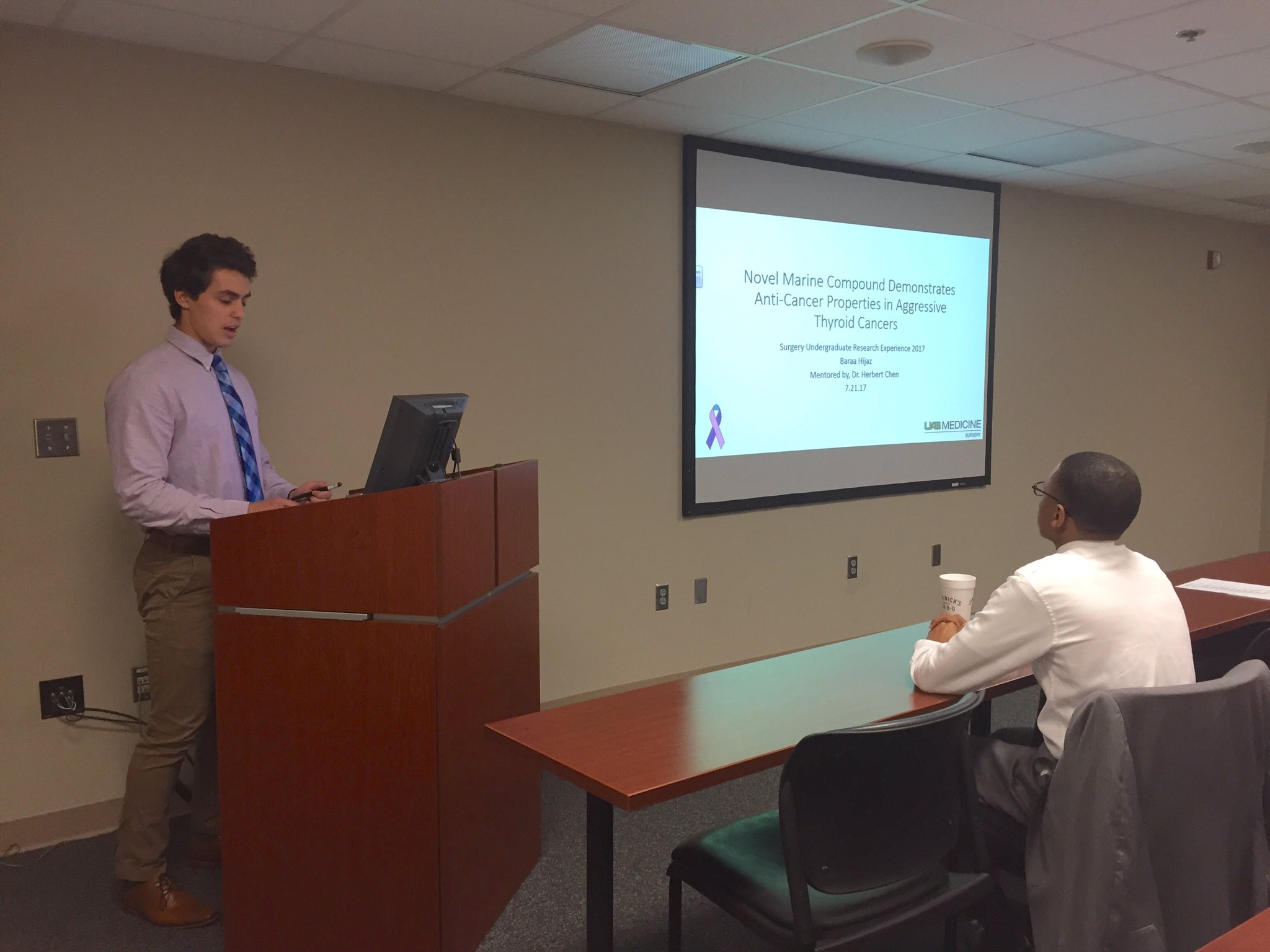
        Two neuroscience students, Baraa Hijaz and Benjamin Borg, were accepted into the Surgery Undergraduate Research Experience (SURE) summer program. Although Hijaz had research experience since he started his freshman year, he explained the SURE program aims to guide students aspiring to be physician scientists through the career process and provides an innumerable amount of opportunities for the students. While working on his own project, he was allotted times to shadow top tier surgeons and surgeon scientists, attend seminars ranging from GRE prep to research career development, and present at regional conferences and the UAB Summer Expo. Because his current trajectory is to aim at attaining a MD/PhD or pursuing a post doctoral fellowship after medical school/residency, he felt that this program was a perfect fit.


        He said one of the main benefits of the program was the independence he was able to experience. 
        "I believe that in order for a student that is new to science to truly excel, some degree of independence is necessary. After I received my initial training and learned most of the necessary techniques and experiments by my mentor, it was up to me to plan and execute the remainder of my experiments for my project. Dauntingly, this required me to read more literature and learn new things by trial and error. Doing so, however, led to a greater understanding of the overarching objective and the specificities of every experiment I conducted, ultimately allowing me to learn more and exceed my own expectations," Hijaz said. 
        Outside of research, he was able to make new friends with other summer students, including medical students, residents, and undergraduate students from different institutions. One of the students taught him better ways to cook and meal prep, and was also his new gym buddy! 
        "My mentor, Dr. Herbert Chen, took the lab to Trident Marina at Smith Lake, one of the cleanest lakes in the United States. There I learned to jet ski, water board, and surf!" (Pictured below)
        He began writing his statement of interest around late December before the February application deadline. If you are interested in exploring similar opportunities, this is what he has to say: 
        "I would mainly advise that students understand why they would like to pursue research. These programs are largely centered on students who are truly passionate about the investigative effort and hope to one day make a difference in the world through their endeavors in science. You will enjoy every second you spend at the bench if you are truly impassioned about the difference you’re making by conducing research. Keep your grades up, stay active on campus, and pursue your passions; this will take you a long way."


        Baraa Hijaz is a sophomore in the neuroscience program, in the Science and Technology Honors program, and a research ambassador at the Office of Undergraduate Research. You can reach him at bhijaz@uab.edu. 
        https://www.uab.edu/medicine/surgery/SURE


        Contributed by Baraa Hijaz 
        Edited by Isabella Mak


        Thursday, April 6, 2017

        ADVENTURE OF A LIFETIME

        By Coldplay Emily Jennings

        Travelling abroad does not seem like something STEM majors have time to do, what with all of the course requirements, research, and various other activities students have going on in their lives. Well I am here to tell you that that is 100% NOT true.
        Edinburgh, Scotland: Edinburgh Castle


        Until the winter of 2015, I did not think I would get the chance to study abroad. Like many other STEM majors, I was trying to balance a lot at one time: research, academics, a leadership role, volunteering, four minors, and somehow also my health. Life was going well for the most part, but I felt like science was all I ever did. I decided it was time for a break. I needed to do something I had always wanted to do while I had the chance; so, I decided to study abroad for one semester.

        One day I was walking around the fifth floor of Heritage Hall when I saw a flyer for a study abroad experience in Scotland. I knew I had to go, and for three main reasons: my ancestry, my favorite hobby, and my desire to visit the Isle of Skye.

        Besides being the home of my ancestors, Scotland is also one of the best places to pursue my favorite hobby: history! I am absolutely a history fanatic, and UAB does not offer history courses in one of my favorite topics, British medieval history. When I read the lists of medieval history courses offered by universities in Scotland, I became super excited. I was finally presented with the opportunity to learn about and discuss my favorite topic with people who cared about that topic in the country responsible for that topic! What could possibly be cooler than that?!

        Quiraing, Isle of Skye, Scotland (I'm still amazed I actually took 
        this picture. This just goes to show how beautiful Scotland really is)

        The next steps were choosing the right program and preparing my application. The University of Stirling was my first-choice program two reasons. First, the program at Stirling is an exchange program, which means I paid the same tuition fees to study abroad as I would have paid to spend the semester at UAB. Second, Stirling is basically in the middle of Scotland and very accessible, making it easy to travel.

        As for the actual process of applying for study abroad programs, it is very simple. All I had to do was create an account on the UAB Education Abroad website, fill out the requested documents, and meet with Ms. Megan Talpash to go over the other necessary steps. Once I was accepted to the University of Stirling, I began applying for study abroad scholarships. Once that was all done, I just had to wait for my departure date. On September 8, 2016, I flew to Scotland.

        For the first month, I spent the weekends travelling, mostly within the bounds of Scotland. As someone who has travelled around continental Europe, I thought it was best that I got to know the country in which I was studying rather than trying to visit the rest of Europe; so, I went on adventures to Loch Ness, Inverness, Edinburgh, and the Shetland Islands to name a few. The greatest adventure of all of my trips was the weekend I spent on the Isle of Skye.

        As I mentioned above, the Isle of Skye is one of the main reasons I chose to study in Scotland. A few years ago, I saw several pictures of the Isle of Skye on Pinterest. I was absolutely amazed at the stunning, rugged beauty portrayed and decided that I needed to visit such a magical-looking place. I spent my second weekend in Scotland driving and walking around the Isle of Skye, taking gorgeous pictures in the process. Those pictures serve as proof of the incredible scenery on the Isle of Skye, which is, in my opinion, the most beautiful place in the world. I encourage you all to visit some day.
        Stirling, Scotland: Stirling Castle and adjoining graveyard


        After a month of travelling around Scotland, I began to explore more of Stirling. I also became involved with the fencing club, one of the many athletics clubs at the University of Stirling. I had never fenced before but had always wanted to do so. With the encouragement of one of my flatmates (also a study abroad student), I became a fencer. Not only was the sport great fun, the people were so kind! Though I was a beginner, everyone in the fencing club was very encouraging and always willing to lend a helping hand, a common trend across the entire university.

        Travelling and joining the fencing club were great experiences, but the most important part of my entire study abroad experience was the people I met. My flatmates, classmates, and the fencing club members were all wonderful people, and many of them have become some of my dearest friends. It was those wonderful people who made my entire study abroad experience so memorable and fun. There is no doubt that, while Scotland is stunningly beautiful and full of history and things to do, I would not have had the time of my life were it not for the people I met.

        Uig, Isle of Skye, Scotland
        Overall, my study abroad experience was absolutely incredible. There is no way it could have been any better than it was. I made new friends, picked up a new sport, indulged in one of my favorite hobbies, visited the land of my ancestors, and grew as a person. That last point is one of the biggest reasons why I think study abroad is such an invaluable experience: it helps you to learn more about yourself and grow as a person. Just generally travelling also helps one to learn about his- or herself, but, as someone who has travelled a lot, I strongly believe actually living somewhere helps you to grow in a different way because it is a different type of experience. No vacation or backpacking trip compares to actually living in a different country and culture.

        I was asked to also comment in this article on whether or not my study abroad experience changed my undergraduate experience. I would like to say that it completely altered my undergraduate experience. Studying abroad led me to change part of my post-graduation plans.

        Stirling, Scotland: At the top of Wallace Monument

        Spending a semester away from science allowed me to step back and think hard about what I want to do with my life and what will make me happiest in the long run. A few months before leaving for Scotland, I decided to delay my medical school applications for one year in order to pursue a super cool master’s program in neuroscience. My experience abroad made me more comfortable with that decision and provided assurance that I am moving along the right career path. Living in Stirling specifically made me realize that I do not feel at home anywhere in the world as much as I do in Scotland; so, I will be moving back to Scotland after completing my master’s degree and only applying to medical schools in Scotland. This is a massive change from the ultra-organized and planned out person I was before studying abroad; but, in the end, life happens, people change, and things do not work out as they are planned, which is perfectly okay. It’s the unexpected events that make life so fun and worth living.

        In conclusion (kudos to you folks who have made it this far), STEM majors can study abroad, and they should. I am a STEM major who studied abroad, and it was possible because I completed all but one of my major classes and most of my thesis before senior year. I had designated senior year as the time to complete all of my minors, but I decided that learning about physics, biology, and psychology are all things I can do later; you only get one chance to study abroad, and that is your university years. I could not pass up the opportunity, so I dropped three of my four minors and made the time to study abroad.

        So, for all of you undergraduate students reading this article, my advice to you is this: study abroad, and while you’re at it, step out of your comfort zone, try things you’ve never done before, go on adventures, and don’t be afraid to make friends. It just might change your life! Also, if you’re going to study abroad, try mixing things up a bit. Don’t take all science classes. Take some classes that have to do with the culture of the area in which you are studying. It will definitely enhance your experience. Going along those same lines, even if you do not study abroad, don’t be afraid to pursue areas of interest outside of science just because you want to be a scientist or physician (or both). We all know that science is fun, challenging, interesting, and rewarding, but it is not the only part of life that matters. In order to really appreciate life and all that it has to offer, you need to do more than just science. Just like blue is the best color in the rainbow, but it’s not the only one; you have to look at all of the colors to appreciate a rainbow’s beauty.

        If you're interested in finding out more information about study abroad, please check out the UAB Education Abroad website!
        Isle of Skye, Scotland: The Cuillin (a mountain range in the south portion of the island)
        Urquhart Castle on Loch Ness
        Eilean Donan Castle, Scotland
        Glendale, Isle of Skye, Scotland: one of
        four sets of rainbows I saw that day

        Stanage Edge in the Peak District
         National Park in England
        Stirling, Scotland: A walk up Dumyat
        about 1 hour before sunset

        Bigton, Shetland Islands: Beach to
        St Ninian's Isle
        Arthur's Seat, Edinburgh, Scotland
        Stirling, Scotland: The Beheading Stone
        on Gowan Hill with Wallace Monument
        in the background
        Stirling, Scotland: The bell tower from
        the ruins of Cambuskenneth Abbey, where
        King James III of Scotland is buried
        University of Stirling: Dormitories
        with Dumyat (the big hill that is
        actually a part of a mountain range)
        in the background
        Glenfinnan, Scotland: Glenfinnan
        Viaduct (where the Hogwarts Express
        was filmed travelling to Hogwarts)
        The Storr, Isle of Skye, Scotland
        Sumburgh, Shetland Islands: an
        Iron Age wheelhouse at Jarlshof,
        an archaeological site dating
        backto the Neolithic Period
        Bakewell, England: Chatsworth House
        (The family home of Henry Cavendish,
        the guy who determined the composition
        of water and recognized hydrogen as an
        element; also the location where the 2005
        version of Pride & Prejudice was filmed)
        Glasgow, Scotland: Buchanan Street